

Can You Swim on Your Period? The Honest Answer
A lot of us grew up with the idea that you simply don't swim on your period unless you're using a tampon. That's not really about biology, it's about not having the right product. Water...

If you've noticed your daughter growing quickly, getting a bit moody, or asking questions she never used to ask, you might already suspect her first period isn't far off. Trusting that instinct is worth it. There are some genuine physical signs that tend to show up in the months before a first period, and knowing them means you can prepare quietly, without making a big thing of it before she's ready.
I'm Danielle, founder of Eco Period, and I've spent years talking with mums about exactly this moment. Here's what to actually look out for.
A growth spurt. For most girls, a noticeable growth spurt happens around a year or so before their first period. If she's suddenly taller, or her shoe size keeps changing, this is often one of the earliest signs.
Breast development. This typically starts around two years before the first period, though it varies a lot from person to person.
Underarm and pubic hair. This tends to appear roughly six months to a year before menstruation begins.
Vaginal discharge. A clear or whitish discharge in her underwear, often starting three to six months before her first period, is one of the more reliable near-term signs. This is completely typical and usually goes unnoticed unless you're looking for it.
Acne or oilier skin. Hormonal shifts around this age often show up on the skin first.
None of these signs guarantee an exact timeline. Every body moves through puberty at its own pace, and the gap between the first signs and the first period can range from several months to a couple of years.
Alongside the physical changes, you might notice mood swings that feel new or more intense, a bit more self consciousness about her body, or increased interest in what other girls her age are talking about or dealing with. She might ask questions indirectly, through a book, a show, or a friend's experience, rather than asking about herself directly. That's often her way of testing the waters before asking outright.
You don't need a big sit down conversation the moment you spot the first sign. What helps most is making the topic feel normal and low pressure well before it happens, so when her first period does arrive, it's not a surprise she has to figure out alone.
A few practical things that help:
This is exactly why we built the First Period Kit. It takes the guesswork out of what to actually have on hand, so you're not scrambling to figure out sizing or product types at the exact moment she needs it. The Essentials Kit covers the basics for $59, and the Deluxe Kit at $99 includes a fuller range if you'd rather have more covered from day one.
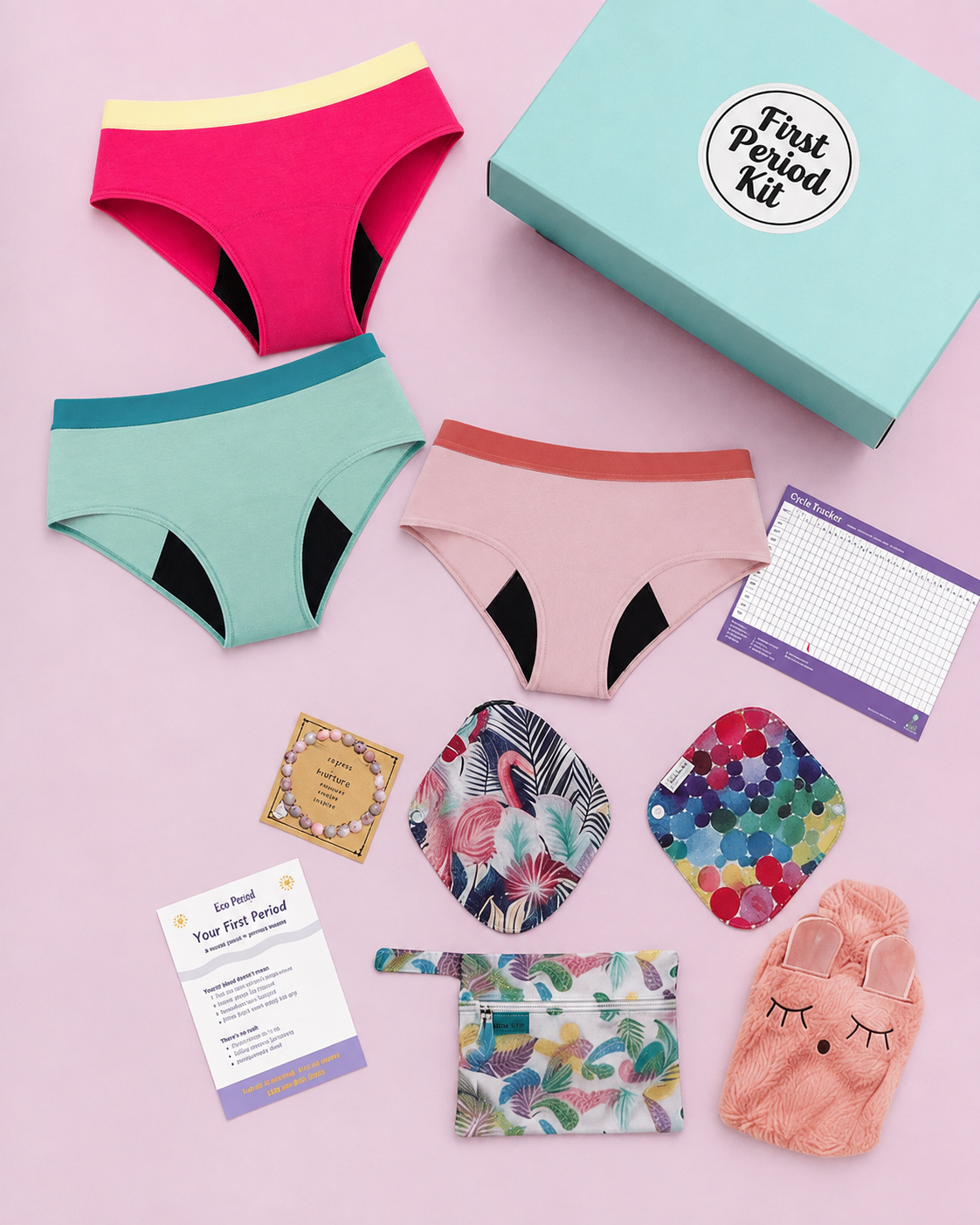
Having something ready in the cupboard, even months before you think she'll need it, takes the pressure off both of you. It also means her first experience with period care can start with something comfortable and reassuring, rather than a rushed trip to the shops.
Even with the best preparation, first periods have a habit of arriving at school, at a friend's house, or on a family outing rather than at a convenient moment at home. This is exactly why having something small and discreet in her school bag matters so much. A single pad or a spare pair of period underwear tucked into a pencil case means that if it happens before you've had the full conversation, she's not left panicking or having to ask a teacher or friend for help. Knowing it's there, even if she never needs it for months, can genuinely ease a lot of quiet anxiety for her.
Something I hear often from mums in our community is that the lead up feels more nerve-wracking than the actual moment itself. Most girls, once they've got something practical on hand and know roughly what to expect, handle their first period with far more composure than their parents expected. The preparation is really for both of you, it gives her confidence and gives you one less thing to worry about timing perfectly.
It also helps to remember this isn't a single conversation you need to get exactly right. It's an ongoing, low-key topic that can come up in the car, while shopping, or while watching a show together. The goal isn't a perfect talk, it's an open door she knows she can walk through whenever she's ready.
Recognising these signs isn't about predicting an exact date. It's about giving yourself a bit of a head start, so when the day comes, you've already normalised the conversation and there's something ready for her to use. That small bit of preparation can make a genuinely big difference to how she experiences this milestone, and it sets the tone for how she'll think about her body and her periods for years to come.

